

.png)
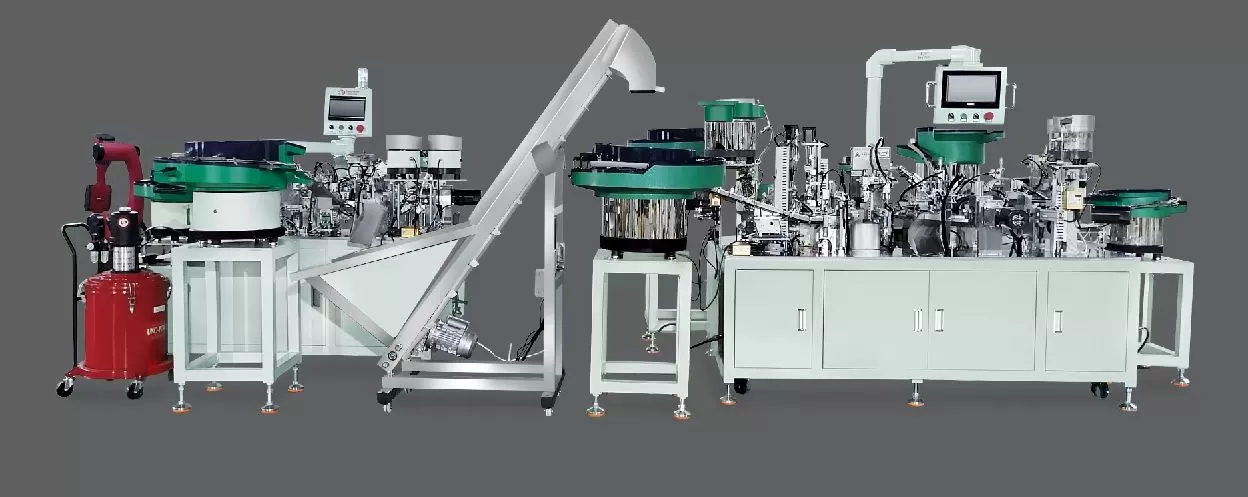
The Jieyang Hinge Automatic Assembly Machine is a critical piece of equipment in modern hinge manufacturing, designed to streamline production, reduce manual labor, and ensure consistent product quality. As a leading manufacturer of automatic assembly machines, Sanyhore has dedicated years to optimizing such equipment, integrating advanced mechanical and control systems to meet the demands of high-volume hinge production. This article outlines the key steps in operating this machine, providing insights into its practical application and benefits for hinge manufacturers.
Machine Preparation
Before initiating production, thorough preparation is essential to ensure the machine operates safely and efficiently. First, confirm the power supply is stable, with voltage and current matching the machine’s specifications (typically 220V/380V, 50Hz). Next, check the air pressure in the pneumatic system, ensuring it ranges from 6 to 8 bar to power components like cylinders and solenoid valves. Lubrication is another critical step: daily inspection of oil levels in gearboxes and sliding rails, with scheduled refills using recommended lubricants (e.g., 46hydraulic oil) to minimize friction and wear. Additionally, verify that all emergency stop buttons, safety guards, and sensors are in place and functional, as these prevent accidents and ensure compliance with industrial safety standards. Finally, power on the control system and wait for the HMI (Human-Machine Interface) to initialize, confirming all indicators show "ready" status before proceeding.
Component Loading
The next phase involves loading raw materials and parts into the machine. The hinge assembly process requires several components, including hinge bases, pins, springs, and covers. To ensure smooth operation, raw materials should first undergo preprocessing: cleaning to remove debris, deburring sharp edges, and sorting to ensure parts are free from defects (e.g., cracks, deformation). For efficient loading, the machine is equipped with automatic feeding systems, such as vibration feeders or linear conveyors, which sort and orient parts by shape and size. Operators place preprocessed parts into designated料斗 (hoppers) or onto feeding trays, where they are then transported to the assembly station via the machine’s integrated conveyor. A key consideration here is preventing component jams: the feeding system should be adjusted to match part dimensions, and operators must periodically check for misaligned parts to avoid halting production.
Assembly Execution
Once the machine is prepared and components are loaded, the assembly execution phase begins, the core of the operation. The process starts with the control system sending signals to the machine’s mechanical arms or grippers, which pick up individual parts based on preprogrammed sequences. For example, a gripper first retrieves the hinge base from the feeding tray and positions it on the main assembly table, where a locating pin ensures precise placement. Next, the spring is fed into the gripper, which then inserts it into the base’s designated slot, guided by a precision guide rod to avoid misalignment. Concurrently, the pin is positioned above the base and spring, and the machine’s press cylinder applies controlled force to insert the pin, ensuring a secure fit (typically with a slight interference fit to prevent loosening during use). Finally, the hinge cover is placed over the assembled components, and the machine performs a final press to lock all parts together, completing the basic assembly. Throughout this phase, the machine’s PLC (Programmable Logic Controller) continuously monitors parameters like pressure, position, and speed, adjusting in real time to maintain consistency.
Quality Inspection
After assembly, a rigorous quality inspection step ensures the produced hinges meet the required standards. The inspection process is automated to minimize human error and improve efficiency. The machine integrates vision systems and sensors to check key quality indicators: first, a camera scans the assembled hinge to verify part alignment, detecting any misplacements or gaps between components (e.g., cover and base). Next, a force sensor tests the hinge’s opening and closing resistance, ensuring the spring tension is within the specified range (e.g., 2-4N for smooth operation). Additionally, a dimension measurement system checks critical dimensions like pin depth and overall thickness, using laser or ultrasonic sensors to confirm compliance with engineering drawings. Rejected hinges are automatically diverted to a reject bin, while qualified ones proceed to the next stage. This inspection step is crucial for maintaining the machine’s reputation for producing high-quality hinges, which in turn enhances customer trust in Sanyhore’s equipment.
Post-Processing & Maintenance
Following inspection, the final step is post-processing and routine maintenance. Qualified hinges are collected from the output conveyor and packaged into cartons, ready for storage or shipment. For the machine itself, post-shift maintenance is critical to ensure long-term reliability. This includes cleaning the assembly area and conveyor tracks to remove dust and debris, checking for loose screws or worn parts (e.g., gripper pads, O-rings), and replenishing lubricants as needed. Weekly maintenance involves more in-depth checks: inspecting the timing belts for wear, calibrating the vision system to ensure accurate part detection, and testing the press cylinder’s pressure output. By adhering to these maintenance schedules, the machine’s service life is extended, and production downtime is minimized, allowing manufacturers to maximize output and reduce operational costs.
As a professional manufacturer of hinge assembly machines, telescopic drawer slide assembly machines, and roll forming machines, Sanyhore is committed to providing reliable, efficient, and user-friendly equipment to meet diverse production needs. Whether you are a small-scale hinge producer or a large manufacturing facility, our automatic assembly machines are designed to boost productivity and product quality. For detailed information, technical support, or to discuss your specific production requirements, please contact our sales manager at +86 13425506550 or send an email to info@sanyhore.com. We look forward to partnering with you to drive your manufacturing success.


