
.png)
The Role of Hydraulic Technology in Modern Assembly
In today’s fast-paced manufacturing landscape, precision, efficiency, and reliability are non-negotiable for assembly processes. Among the technologies driving this demand, hydraulic systems stand out for their ability to deliver consistent force, precise control, and adaptability to diverse production needs. Sanyhore, a leader in assembly machine innovation, has harnessed the power of hydraulics to redefine how machines are conceptualized, designed, and built—transforming abstract customer requirements into tangible, high-performance tools. This article explores Sanyhore’s hydraulic approach, from the initial spark of an idea to the final machine ready for industrial use.
Conceptualization: Translating Customer Needs into Machine Design
Every Sanyhore machine begins with a clear understanding of customer needs. Before a single component is engineered, the team engages closely with clients to identify specific challenges: What are the production volume targets? What material thicknesses or part tolerances are required? For example, a furniture manufacturer might seek a hinge assembly machine that handles small, lightweight hinges with minimal manual intervention, while an automotive supplier could prioritize a telescopic drawer slide assembly machine capable of high-speed, repeatable insertion of tiny components.
At this stage, Sanyhore’s engineers focus on translating these needs into a hydraulic system blueprint. Hydraulic technology is chosen not only for its inherent precision but also for its ability to handle varying loads—critical for both hinge assembly (which requires delicate force application to avoid damaging materials) and telescopic slide assembly (where consistent pressure ensures smooth movement and durability). The goal: a machine design that balances power, speed, and user-friendliness.
Engineering & Prototyping: Refining the Hydraulic System
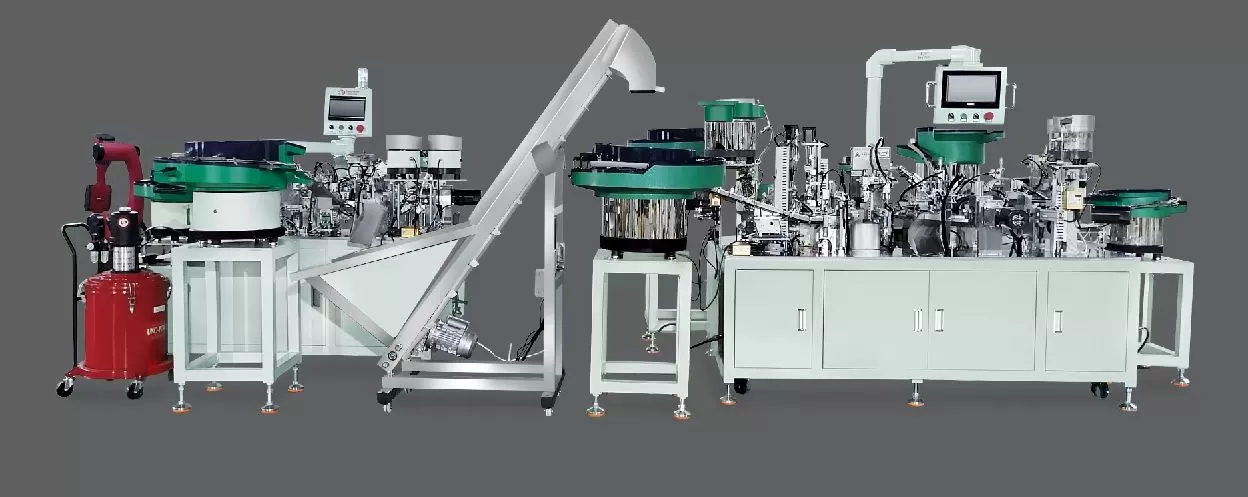
Once the concept is defined, Sanyhore’s engineering team dives into detailed design. Using advanced CAD software, they model the hydraulic circuit, determining factors like pump flow rates, cylinder specifications, and control systems to ensure the machine meets the performance criteria. For instance, a telescopic drawer slide assembly machine requires a hydraulic system that can adjust pressure dynamically as slides of different lengths pass through the assembly station—ensuring each joint is secured with the exact force needed.
Prototyping is a critical step in refining this design. Sanyhore builds initial prototypes to test the hydraulic system under real-world conditions: Does the pressure hold consistently? Is the cycle time efficient enough to meet production demands? If issues arise—such as uneven force distribution or excessive energy consumption—the team iterates, adjusting valve configurations or cylinder dimensions until the prototype performs flawlessly. This iterative process ensures the final machine isn’t just functional, but optimized for the customer’s unique workflow.
Production & Quality Assurance: Scaling the Hydraulic Approach
With the prototype validated, Sanyhore shifts to production readiness. The hydraulic system is integrated into a robust, modular frame, designed to minimize vibration and ensure stability during long production runs. Materials are carefully selected—high-strength steel for structural components, corrosion-resistant alloys for parts in contact with finished products—to guarantee longevity in industrial environments.
Quality control is rigorous at every stage. Before leaving the factory, each machine undergoes extensive testing: pressure tests to verify hydraulic system integrity, load tests to ensure component durability, and performance checks to confirm cycle times and precision. For example, a roll forming machine for滑轨 (telescopic drawer slides) is tested to ensure it can form metal strips into the required profiles with tight tolerances, while hinge assembly machines are validated for repeatable insertion force within ±2%—a standard that ensures consistent hinge performance in end products.
From Bench to Industry: Sanyhore’s Commitment to Reliability
Sanyhore’s hydraulic approach isn’t just about building machines—it’s about building partnerships. Since 2005, the company has focused on one goal: delivering assembly solutions that reduce customer downtime, lower operational costs, and enhance product quality. This commitment is reflected in every machine: whether it’s a compact hinge assembly machine for small workshops or a high-speed telescopic slide assembly line for automotive plants, Sanyhore’s hydraulically driven systems are engineered to adapt to evolving industrial needs.
Customers often praise the machines for their low maintenance requirements and seamless integration with existing production lines. One client, a global furniture manufacturer, noted that Sanyhore’s hinge assembly machine reduced their defect rate by 30% and increased output by 20% within the first three months of installation. Such results aren’t accidental—they’re the product of Sanyhore’s dedication to understanding, designing for, and perfecting the hydraulic assembly process.
Contact Sanyhore: Your Partner in Hydraulic Assembly Solutions
Ready to transform your production line with a hydraulic assembly solution tailored to your needs? Sanyhore’s team of engineers is here to guide you from concept to completion. Whether you require a custom hinge assembly machine, a telescopic drawer slide assembly system, or a roll forming machine for滑轨, we combine technical expertise with hands-on problem-solving to deliver results.
Connect with us today to discuss your project:
Sales Manager: +86 13425506550
Email: info@sanyhore.com
Sanyhore—where precision meets partnership, and your assembly challenges become our engineering opportunities.


