

 - 副本.png)
The manufacturing hub of Jieyang, Guangdong, has long been a cornerstone of China’s hardware production, but in recent years, it has emerged as a trailblazer in 3D hinge assembly innovation. Driven by market demands for precision, efficiency, and versatility, local factories are redefining production standards, integrating cutting-edge technologies to overcome traditional limitations. This shift not only elevates product quality but also positions Jieyang at the forefront of global hinge manufacturing, with companies increasingly relying on advanced assembly solutions to stay competitive.
The Rise of 3D Hinge Assembly in Jieyang’s Manufacturing Landscape
3D hinge assembly, once a niche process, has become a focal point for Jieyang factories due to its ability to produce hinges with multi-directional movement and structural stability. Unlike 2D hinge designs, 3D hinges require precise alignment across three axes, demanding sophisticated machinery and meticulous engineering. Local manufacturers initially struggled with manual adjustments, leading to inconsistencies in performance and higher defect rates. However, recognizing the need to meet global market expectations—such as those from consumer electronics, furniture, and automotive industries—factories began investing in automated systems to streamline 3D assembly.
Leveraging Automation and Smart Systems for Precision
A key innovation in Jieyang’s 3D hinge production is the adoption of automated assembly lines integrated with 3D modeling software and sensor-based quality control. Traditional methods relied heavily on human operators, whose experience was the primary determinant of assembly accuracy. Today, factories use Computer-Aided Design (CAD) and Computer-Aided Manufacturing (CAM) tools to simulate hinge movement, ensuring components align perfectly before physical production. Additionally, vision inspection systems and laser measurement tools check each hinge’s 3D tolerances in real time, reducing errors by up to 70% compared to manual checks. This automation not only boosts efficiency but also frees up labor for more complex tasks, such as optimizing production workflows.
Technological Breakthroughs in hinge assembly machine Design
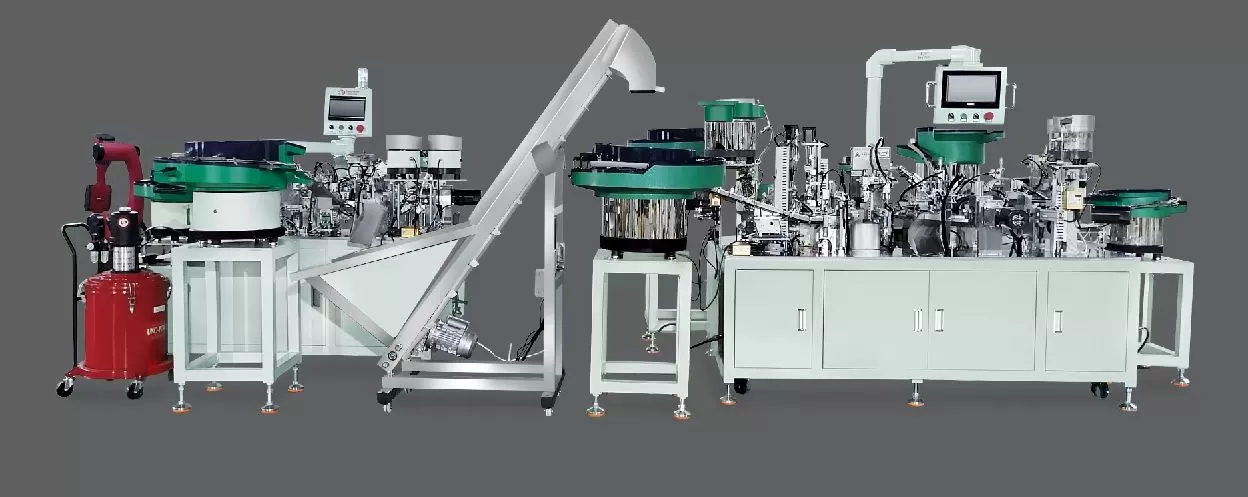
Central to this transformation are specialized hinge assembly machines tailored for 3D applications. These machines, often developed in collaboration with local R&D teams, feature multi-axis robotic arms that can position and secure hinges with sub-millimeter precision. Unlike generic machines, they include adaptive grippers that adjust to different hinge sizes and materials, from stainless steel to aluminum alloys. Jieyang factories have also integrated IoT capabilities into these machines, allowing real-time monitoring of operational data—such as tool wear, assembly speed, and error rates. This connectivity enables predictive maintenance, minimizing downtime and ensuring consistent output.
Telescopic Drawer Slide Assembly: Meeting Modern Market Demands
Beyond 3D hinges, Jieyang factories are also advancing in telescopic drawer slide assembly, a critical component in furniture and storage solutions. Telescopic drawer slides require smooth, durable movement, which demands precise alignment of multiple rails and ball bearings. To address this, manufacturers now use specialized telescopic drawer slide assembly machines equipped with automated feeding systems and press-fit mechanisms. These machines can handle high-volume production while maintaining tight tolerances, ensuring slides extend and retract with minimal resistance and long service life. This innovation has made Jieyang a go-to source for global furniture brands seeking reliable, cost-effective telescopic slide solutions.
Roll Forming: Balancing Strength and Complexity in Component Production
Another pillar of Jieyang’s manufacturing innovation is roll forming technology, used to produce the structural components of hinges and slides. roll forming machines shape metal sheets into complex profiles by passing them through a series of rotating dies, a process known for its efficiency and material consistency. Local factories have upgraded these machines with 3D simulation software, allowing engineers to design dies that accommodate intricate curves and thickness variations—key for creating lightweight yet strong components. This precision roll forming ensures that parts meet strict structural requirements, reducing the need for post-production adjustments and lowering overall production costs.
Driving Industry Growth: Sanyhore’s Commitment to Innovation
As a leading manufacturer of hinge assembly machines, telescopic drawer slide assembly machines, and roll forming machines, Sanyhore has been integral to Jieyang’s 3D hinge assembly revolution. With a focus on R&D, Sanyhore’s machines are engineered to integrate seamlessly with existing production lines, making them accessible to factories of all sizes. The company’s hinge assembly machines, for instance, feature modular designs that can be reconfigured to adapt to new hinge types, while its telescopic slide machines offer customizable speed and precision settings to meet diverse market needs.
For factories looking to embrace 3D hinge assembly innovation, Sanyhore provides the tools to enhance efficiency, reduce waste, and elevate product quality. By combining cutting-edge technology with decades of manufacturing expertise, Sanyhore supports Jieyang’s factories in staying ahead in a rapidly evolving global market.
To learn more about Sanyhore’s hinge assembly machines, telescopic drawer slide assembly machines, or roll forming machines, contact us today. Our team of experts is ready to discuss how our solutions can transform your production process. Call +86 13425506550 or send an email to info@sanyhore.com for a personalized consultation.


