

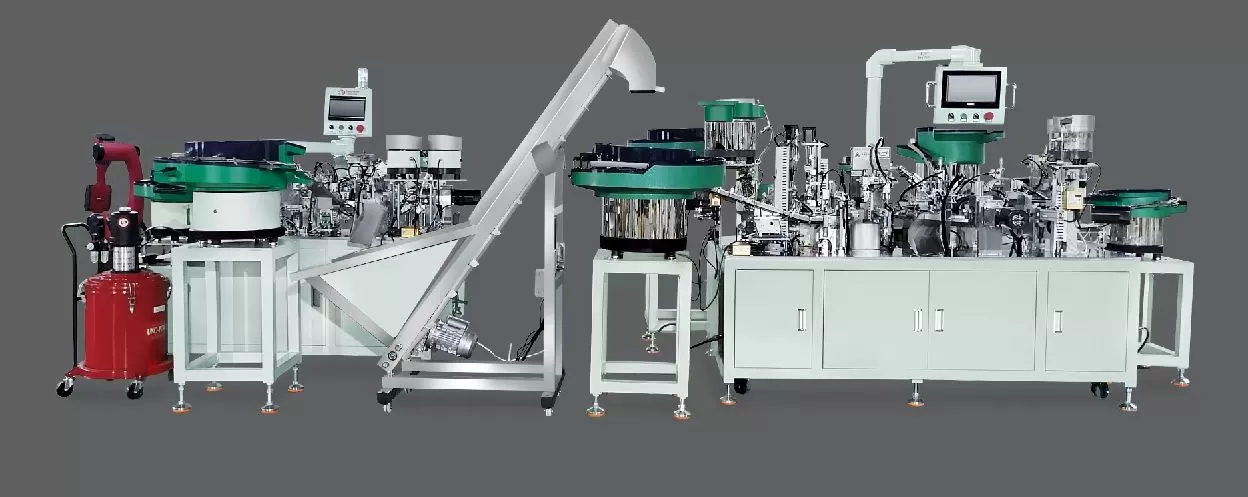
In the dynamic field of drawer slide manufacturing, producers often grapple with persistent operational hurdles that impede productivity, quality, and cost-effectiveness. These challenges range from inconsistent component alignment and low production throughput to high material waste and frequent machine downtime. Sanyhore, a trusted manufacturer of specialized assembly and forming equipment, has developed cutting-edge technologies designed to overcome these pain points, enabling manufacturers to enhance efficiency, reduce errors, and maintain consistent quality throughout the production process.
1. Enhancing Production Efficiency with Automated Hinge Assembly Systems
Traditional hinge assembly processes in drawer slide manufacturing rely heavily on manual labor, leading to variability in component placement and slow production rates. This not only increases labor costs but also results in inconsistent product quality, as human error and fatigue can compromise precision. Sanyhore’s hinge assembly machine addresses this by integrating advanced servo-drive systems and computer-aided vision alignment. Equipped with high-speed cameras and real-time feedback loops, the machine ensures each hinge is positioned within ±0.02mm tolerance, eliminating misalignment issues. By automating the assembly of hinges onto slide tracks, the system achieves production speeds of up to 120 units per minute—nearly double the rate of manual operations—while reducing labor dependency and minimizing rework.
2. Ensuring Precision in Telescopic Slide Manufacturing with Advanced Roll Forming
Telescopic drawer slides require intricate bending and forming of metal components to achieve the required telescopic motion and load-bearing capacity. Conventional methods, such as stamping, often lead to material stretching, warping, and dimensional inaccuracies, increasing scrap rates and post-production finishing time. Sanyhore’s telescopic drawer slide assembly machine incorporates a state-of-the-art roll forming process, which uses a series of precision rollers to gradually shape the metal strip. This continuous, low-stress forming method ensures uniform material flow, reducing internal stresses and achieving dimensional precision of ±0.05mm. By minimizing material waste and eliminating the need for secondary shaping, the roll forming technology significantly lowers production costs and improves the structural integrity of the slides.
3. Reducing Production Costs Through Material Optimization and Lean Design
Material costs represent a significant portion of drawer slide production expenses, with traditional methods often using excessive material thickness to compensate for forming limitations. Sanyhore’s technology integrates material thickness optimization algorithms into its machines, based on load requirements and material properties. For example, the system can adjust forming parameters to use thinner high-strength alloys, reducing raw material usage by up to 15% without compromising durability. Additionally, the modular design of Sanyhore’s equipment allows for quick reconfiguration, enabling manufacturers to switch between different slide sizes with minimal setup time—eliminating the need for expensive dedicated tooling and reducing downtime for product changes.
4. Improving Quality Control with Real-Time Monitoring and Feedback Loops
Maintaining consistent quality across large production runs is challenging, as manual inspection processes are prone to oversight and delays. Sanyhore’s machines are equipped with integrated sensors that monitor key parameters, including forming pressure, roller temperature, and component position, in real time. AI-driven analytics then analyze this data to detect anomalies early, automatically adjusting machine settings to prevent defects before they occur. For instance, if a sensor detects a deviation in slide length, the system will pause production, recalibrate the roll forming tools, and resume only when the issue is resolved. This proactive quality control reduces scrap rates by up to 30% and ensures every slide meets strict industry standards.
5. Streamlining Complex Processes with Modular Machine Integration and Data Connectivity
Modern drawer slide production often involves multiple standalone machines, leading to inefficient workflow and data silos. Sanyhore addresses this with its integrated manufacturing systems, which combine hinge assembly, roll forming, and finishing processes into a single, interconnected line. The machines are designed to communicate via Industry 4.0 protocols, allowing production managers to monitor throughput, tool wear, and material usage in real time through a centralized dashboard. This connectivity also enables predictive maintenance, as the system can alert operators to potential machine issues before they cause unplanned downtime. By streamlining workflows and enhancing data visibility, Sanyhore’s integrated solutions help manufacturers achieve higher overall equipment effectiveness (OEE) and faster time-to-market for new slide designs.
For manufacturers looking to overcome the common challenges of drawer slide production, Sanyhore offers a comprehensive range of machines, including hinge assembly machines, telescopic drawer slide assembly machines, and roll forming machines. With a focus on innovation, precision, and cost efficiency, Sanyhore’s technology is engineered to transform production lines and drive business growth. To learn more about how our solutions can optimize your manufacturing process, contact our team today at +86 13425506550 or send an email to info@sanyhore.com.


