
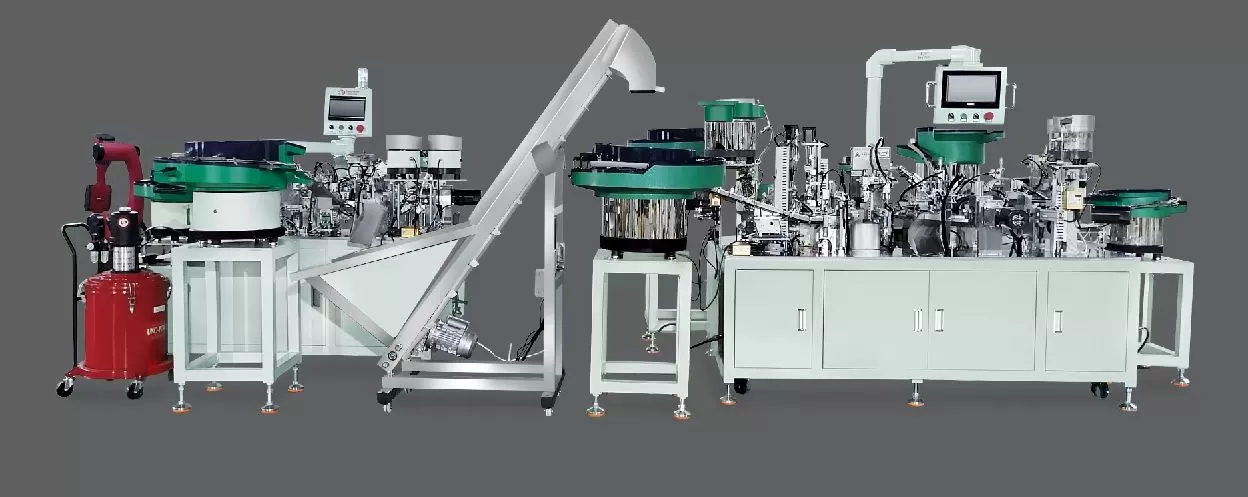
Human-Machine Collaboration Process for Jieyang Hinge Automatic Assembly Machine

2025-12-25


In modern manufacturing, human-machine collaboration (HMC) has evolved from a trend to a necessity, especially in precision industries like hinge production. This article delves into the human-machine collaboration process for Jieyang hinge automatic assembly machines, exploring how human expertise and machine precision converge to redefine production efficiency, quality control, and operational flexibility. As a leading manufacturer of hinge assembly equipment, Sanyhore integrates this collaborative model into its machines, ensuring seamless interaction between operators and automated systems.

Introduction to Human-Machine Collaboration in Hinge Assembly

Human-machine collaboration in hinge assembly refers to a symbiotic workflow where humans and machines each contribute their unique strengths. Unlike fully automated systems that replace human involvement, HMC retains human oversight, creativity, and adaptability while leveraging machines' precision, speed, and consistency. For hinge assembly, this means operators handle tasks requiring judgment, problem-solving, and initial setup, while machines execute repetitive, high-precision steps like component alignment, welding, and press-fitting. This balance not only boosts productivity but also reduces the risk of errors and physical strain on workers.

Core Components of the Hinge Assembly Collaboration System

A robust human-machine collaboration system for hinge assembly relies on three key components: advanced automation hardware, intuitive human-machine interface (HMI), and real-time data integration. The automation hardware includes collaborative robots (cobots) with force-limiting technology, high-precision grippers, and vision systems that inspect components for defects. The HMI, typically a touchscreen panel, allows operators to input parameters, monitor machine status, and adjust workflows. Real-time data integration ensures operators receive instant feedback on production metrics, such as assembly speed, component accuracy, and machine performance, enabling proactive adjustments.

Step-by-Step Process of Human-Machine Collaboration

The human-machine collaboration process for Jieyang hinge automatic assembly machines follows a structured sequence, ensuring clarity and efficiency:

1. Pre-Operation Setup: Before production, the operator loads raw hinge components (e.g., leaves, pins, bushings) into designated inlets. Using the HMI, they input production parameters, such as target speed and component tolerances, based on product specifications.

2. Machine Initialization: The system powers up, with cobots and vision systems calibrating to reference points. Sensors check for component presence and correct orientation, ensuring readiness for assembly.

3. Human-Machine Coordination: The operator performs a quick visual inspection of the first few components, verifying alignment and fit. If adjustments are needed (e.g., misaligned parts), they use the HMI to tweak machine parameters, such as gripper pressure or robotic movement speed.

4. Automated Assembly Execution: The cobot then takes over, executing precise steps: picking components from feeders, aligning them with vision guidance, and joining them using ultrasonic welding or press-fitting. The machine’s speed—often 10-20 cycles per minute—far exceeds manual assembly, reducing cycle time by 60% or more.

5. Quality Control and Feedback: After assembly, the vision system inspects each hinge for critical dimensions (e.g., pin depth, leaf alignment) and functionality (e.g., opening/closing resistance). If a defect is detected, the system pauses, and the operator is notified via visual and audio alerts. The operator then removes the defective unit, and the system resumes production after adjustment.

6. Data Logging and Optimization: Throughout the process, data on production volume, defect rates, and machine runtime is logged. Operators and engineers use this data to identify bottlenecks, refine workflows, and enhance overall system performance over time.

Benefits of Implementing Human-Machine Collaboration

The human-machine collaboration model offers tangible benefits for hinge assembly operations:

- Enhanced Productivity: By offloading repetitive tasks to machines, operators focus on high-value activities, increasing overall production output by up to 40%.

- Improved Quality: Machine precision minimizes errors from human fatigue or inconsistency, reducing defect rates to less than 0.5%.

- Reduced Labor Intensity: Operators avoid repetitive motion injuries, and the system’s user-friendly interface lowers training requirements.

- Flexible Production: The modular design of the collaboration system allows quick reconfiguration for different hinge models, adapting to changing market demands.

Technical Considerations for Seamless Integration

To ensure smooth human-machine collaboration, several technical factors must be addressed:

- Safety Compliance: The system adheres to international safety standards (e.g., ISO/TS 15066 for collaborative robots), with force sensors that stop operations if human contact is detected.

- HMI Usability: The interface is designed with large, clear icons, customizable workflows, and real-time diagnostics to minimize operator learning curves.

- Data Security: Production data is encrypted and transmitted securely, preventing unauthorized access and ensuring compliance with data privacy regulations.

- Maintainability: Components like grippers and sensors are modular, allowing quick replacement to reduce downtime, with predictive maintenance alerts to prevent unexpected failures.

Conclusion and Call to Action

Human-machine collaboration has transformed hinge assembly, merging human judgment with machine precision to create efficient, reliable, and flexible production systems. For manufacturers looking to upgrade their operations, Sanyhore offers cutting-edge hinge automatic assembly machines designed with this collaborative model in mind. As a professional producer of hinge assembly machines, telescopic drawer slide assembly machines, and roll forming machines, Sanyhore provides tailored solutions to meet diverse production needs.

Ready to enhance your hinge assembly efficiency? Contact Sanyhore today to discuss your requirements. Our team of experts is available to provide detailed insights and support. Reach us at +86 13425506550 or via email at info@sanyhore.com.

We use cookie to improve your online experience. By continuing to browse this website, you agree to our use of cookie.

Cookies

Please read our Terms and Conditions and this Policy before accessing or using our Services. If you cannot agree with this Policy or the Terms and Conditions, please do not access or use our Services. If you are located in a jurisdiction outside the European Economic Area, by using our Services, you accept the Terms and Conditions and accept our privacy practices described in this Policy.
We may modify this Policy at any time, without prior notice, and changes may apply to any Personal Information we already hold about you, as well as any new Personal Information collected after the Policy is modified. If we make changes, we will notify you by revising the date at the top of this Policy. We will provide you with advanced notice if we make any material changes to how we collect, use or disclose your Personal Information that impact your rights under this Policy. If you are located in a jurisdiction other than the European Economic Area, the United Kingdom or Switzerland (collectively “European Countries”), your continued access or use of our Services after receiving the notice of changes, constitutes your acknowledgement that you accept the updated Policy. In addition, we may provide you with real time disclosures or additional information about the Personal Information handling practices of specific parts of our Services. Such notices may supplement this Policy or provide you with additional choices about how we process your Personal Information.


Cookies

Cookies are small text files stored on your device when you access most Websites on the internet or open certain emails. Among other things, Cookies allow a Website to recognize your device and remember if you've been to the Website before. Examples of information collected by Cookies include your browser type and the address of the Website from which you arrived at our Website as well as IP address and clickstream behavior (that is the pages you view and the links you click).We use the term cookie to refer to Cookies and technologies that perform a similar function to Cookies (e.g., tags, pixels, web beacons, etc.). Cookies can be read by the originating Website on each subsequent visit and by any other Website that recognizes the cookie. The Website uses Cookies in order to make the Website easier to use, to support a better user experience, including the provision of information and functionality to you, as well as to provide us with information about how the Website is used so that we can make sure it is as up to date, relevant, and error free as we can. Cookies on the Website We use Cookies to personalize your experience when you visit the Site, uniquely identify your computer for security purposes, and enable us and our third-party service providers to serve ads on our behalf across the internet.

We classify Cookies in the following categories:
 ●  Strictly Necessary Cookies
 ●  Performance Cookies
 ●  Functional Cookies
 ●  Targeting Cookies


Cookie List
A cookie is a small piece of data (text file) that a website – when visited by a user – asks your browser to store on your device in order to remember information about you, such as your language preference or login information. Those cookies are set by us and called first-party cookies. We also use third-party cookies – which are cookies from a domain different than the domain of the website you are visiting – for our advertising and marketing efforts. More specifically, we use cookies and other tracking technologies for the following purposes:

Strictly Necessary Cookies
These cookies are necessary for the website to function and cannot be switched off in our systems. They are usually only set in response to actions made by you which amount to a request for services, such as setting your privacy preferences, logging in or filling in forms. You can set your browser to block or alert you about these cookies, but some parts of the site will not then work. These cookies do not store any personally identifiable information.

Functional Cookies
These cookies enable the website to provide enhanced functionality and personalisation. They may be set by us or by third party providers whose services we have added to our pages. If you do not allow these cookies then some or all of these services may not function properly.

Performance Cookies
These cookies allow us to count visits and traffic sources so we can measure and improve the performance of our site. They help us to know which pages are the most and least popular and see how visitors move around the site. All information these cookies collect is aggregated and therefore anonymous. If you do not allow these cookies we will not know when you have visited our site, and will not be able to monitor its performance.

Targeting Cookies
These cookies may be set through our site by our advertising partners. They may be used by those companies to build a profile of your interests and show you relevant adverts on other sites. They do not store directly personal information, but are based on uniquely identifying your browser and internet device. If you do not allow these cookies, you will experience less targeted advertising.

How To Turn Off Cookies
You can choose to restrict or block Cookies through your browser settings at any time. Please note that certain Cookies may be set as soon as you visit the Website, but you can remove them using your browser settings. However, please be aware that restricting or blocking Cookies set on the Website may impact the functionality or performance of the Website or prevent you from using certain services provided through the Website. It will also affect our ability to update the Website to cater for user preferences and improve performance. Cookies within Mobile Applications

We only use Strictly Necessary Cookies on our mobile applications. These Cookies are critical to the functionality of our applications, so if you block or delete these Cookies you may not be able to use the application. These Cookies are not shared with any other application on your mobile device. We never use the Cookies from the mobile application to store personal information about you.

If you have questions or concerns regarding any information in this Privacy Policy, please contact us by email at . You can also contact us via our customer service at our Site.