

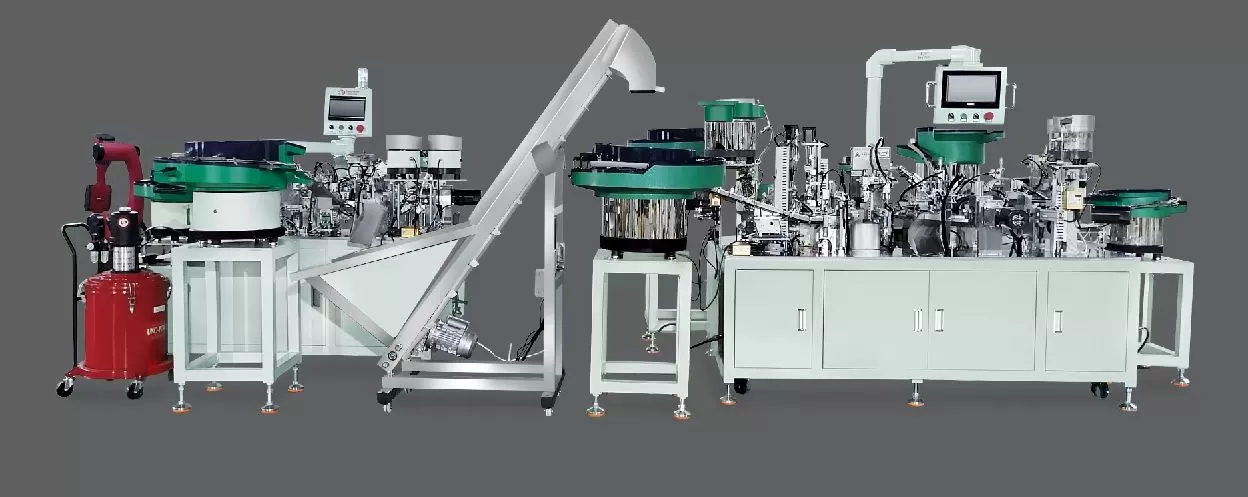
In modern manufacturing, the pursuit of higher production speed often collides with the need to maintain critical quality metrics, especially for components like hinges and drawer slides where soft-closing precision directly impacts user experience. Consumers expect smooth, silent closure, while manufacturers face pressure to reduce cycle times and lower costs. This tension has long been a barrier to scaling production without compromising quality. However, through targeted engineering and smart integration of automation, it’s possible to achieve both: faster throughput and consistent soft-closing performance. Below, we explore key strategies and solutions that enable this balance, with insights from Sanyhore’s expertise in hinge and slide assembly machinery.
Understanding the Trade-off: Speed vs. Precision
Traditional assembly methods frequently prioritize one over the other. For instance, manual or semi-automated systems relying on basic mechanical stops may achieve high speed but struggle with the tight tolerances required for soft-closing hinges. Conversely, precision-focused setups with manual adjustment often slow production, leading to bottlenecks. The root cause lies in how machines interact with components: rapid movement can cause misalignment, while imprecise force application may result in inconsistent damping, affecting the soft-closing feel. To resolve this, engineers must design systems that minimize friction, optimize motion control, and integrate real-time feedback mechanisms.
Key Factors Limiting Speed in Precision Assembly
Several variables hinder simultaneous speed and precision. Mechanical inefficiencies, such as loose bearings or outdated drive systems, can slow movement and introduce delays. Material compatibility is another factor: high-friction components increase wear and require frequent maintenance, halting production. Additionally, manual inspection steps—critical for verifying soft-closing performance—often act as bottlenecks, as they demand time-consuming checks that slow overall throughput. Without addressing these, manufacturers risk sacrificing either speed or quality.
Engineering Innovations to Redefine the Balance
Recent advancements in machine design have shifted this dynamic. For hinge assembly, precision cam systems and servo-driven mechanisms now enable rapid, controlled movement. These systems use pre-programmed motion profiles to ensure consistent contact between hinge components, maintaining the precise damping needed for soft closure while reducing cycle times by up to 40%. Similarly, telescopic drawer slide assembly machines leverage linear guide rails with low-friction coatings, minimizing resistance and allowing faster insertion and locking phases.
Material selection also plays a role. Self-lubricating composites, such as filled PTFE, reduce wear and eliminate the need for frequent lubrication, extending machine uptime and reducing maintenance breaks. Integrated sensors further enhance precision: optical encoders monitor component alignment in real time, adjusting for minor deviations before they compromise soft-closing performance. This "closed-loop" control ensures every unit meets specifications, even at high speeds.
Smart Automation: The Bridge to Efficiency
Automation is a cornerstone of balancing speed and precision. Sanyhore’s assembly lines integrate collaborative robots (cobots) to handle repetitive tasks, reducing human error and enabling 24/7 operation. Vision systems, paired with machine learning algorithms, inspect soft-closing force and travel distance in milliseconds, flagging outliers for immediate rework. By automating these checks, production remains uninterrupted, and quality is maintained at scale.
Data-driven optimization is another game-changer. Machine learning models analyze production data—including cycle times, component tolerances, and machine performance—to adjust parameters dynamically. For example, if a batch of slides shows slightly lower soft-closing force, the system automatically modifies the assembly pressure, ensuring consistency without slowing down.
Quality Control Without Slowing Production
To maintain precision, inline quality control must be seamless. Sanyhore’s machines include integrated test stations that simulate real-world usage: a pneumatic actuator applies the closing force, while sensors measure rebound and force decay, ensuring compliance with industry standards. Statistical Process Control (SPC) tools track these metrics over time, identifying trends early to prevent large-scale quality issues. This proactive approach eliminates post-production rework, keeping lines running at peak efficiency.
Sanyhore: Your Partner in Balancing Speed and Precision
For over a decade, Sanyhore has specialized in engineering hinge assembly machines, telescopic drawer slide assembly machines, and roll forming machines that redefine what’s possible in production speed and precision. Our machines combine custom-engineered mechanics, adaptive automation, and rigorous testing to deliver consistent soft-closing performance, even at high throughput. Whether you need to scale furniture component production or enhance automotive hinge reliability, our solutions are designed to grow with your needs.
Ready to transform your assembly line? Contact Sanyhore today to discuss how our machines can boost your production speed while maintaining the soft-closing precision your customers demand.
Sales Manager: +86 13425506550
Email: info@sanyhore.com
Common SEO Questions & Answers for Hinge and Slide Assembly
1. Q: How do Sanyhore’s machines achieve both speed and soft-closing precision?
A: Our systems integrate precision cam designs, servo drives, and real-time sensor feedback to minimize cycle times while maintaining tight tolerances for soft-closing mechanisms.
2. Q: Can your machines handle custom production requirements for hinges or slides?
A: Yes, Sanyhore specializes in tailored solutions, including custom hinge assembly machines and telescopic slide assembly machines, to match your unique output and quality needs.
3. Q: What types of industries benefit most from your balancing speed and precision solutions?
A: Automotive, furniture, and consumer electronics manufacturers seeking to scale production while upholding soft-closing quality will find our roll forming machines and assembly systems highly valuable.
4. Q: How do you ensure long-term reliability in high-speed assembly machines?
A: We use high-grade materials and modular designs, with built-in diagnostics to detect and address issues before they impact performance, ensuring consistent operation over time.
5. Q: Can your machines integrate with existing production lines?
A: Absolutely. Our machines are designed for easy integration, with flexible interfaces to work alongside your current systems, minimizing downtime during implementation.


