

.png)
Jieyang, a city long recognized as a global manufacturing powerhouse, has recently emerged as a trailblazer in redefining 3D hinge assembly manufacturing. Once known primarily for traditional hardware production, the region has strategically leveraged technological advancements and industry expertise to transform how 3D hinges—critical components in electronics, furniture, and automotive sectors—are designed and assembled. This shift is not just about scaling production; it’s about elevating precision, reducing costs, and setting new benchmarks for efficiency in the global hinge market.
The Evolution of Hinge Manufacturing in Jieyang
Jieyang’s manufacturing journey began with basic, low-complexity components, relying on manual labor and conventional tools. However, over the past decade, the city has invested heavily in upgrading infrastructure, fostering R&D collaborations, and integrating smart technologies. This transformation was catalyzed by the growing demand for 3D hinges—components requiring intricate tolerances, multi-axis movement, and seamless integration of materials. Unlike traditional 2D hinge designs, 3D hinges demand precise alignment of multiple parts, making their assembly a technically challenging process. Jieyang’s manufacturers rose to this challenge by adopting automation, 3D modeling, and advanced metrology tools, laying the groundwork for a new era in hinge production.
3D Hinge Assembly: The Technological Breakthrough
At the heart of Jieyang’s revolution is the adoption of 3D hinge assembly technology. Conventional methods often relied on trial-and-error adjustments, leading to inconsistencies and higher defect rates. Today, 3D hinge assembly manufacturing in Jieyang integrates computer-aided design (CAD) for prototyping, computer numerical control (CNC) machines for precise cutting, and vision systems for real-time quality checks. This synergy allows for the simultaneous assembly of three or more components, ensuring each hinge meets strict dimensional and functional standards. For instance, a 3D hinge in a premium laptop, which requires smooth rotation across 360 degrees, can now be assembled with sub-millimeter precision, reducing failure rates by up to 40% compared to traditional methods.
Local Expertise and Global Supply Chains
Jieyang’s success in 3D hinge assembly manufacturing stems from its unique blend of local expertise and global connectivity. The city’s workforce, trained in advanced manufacturing techniques, works alongside international engineers and material scientists to refine production processes. This collaboration has led to innovations such as lightweight, high-strength hinge designs using aerospace-grade alloys, which are now supplied to major electronics and automotive brands worldwide. Additionally, Jieyang’s proximity to raw material suppliers and logistics hubs has reduced lead times, making it a preferred manufacturing destination for global companies seeking reliable, high-quality 3D hinge components.
Sanyhore: Powering the 3D Hinge Revolution
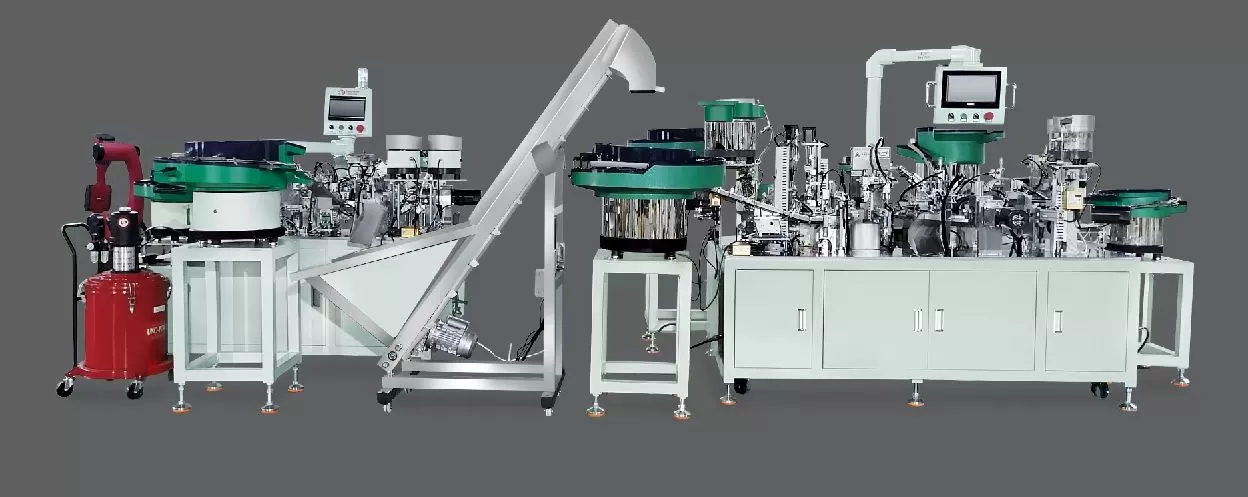
As a key player in Jieyang’s manufacturing ecosystem, Sanyhore has been at the forefront of delivering cutting-edge solutions for 3D hinge assembly. Specializing in the design and production of hinge assembly machines, telescopic drawer slide assembly machines, and roll forming machines, Sanyhore’s equipment is engineered to meet the demands of modern 3D hinge manufacturing. Our machines integrate 3D vision systems, servo-driven mechanisms, and AI-based quality control, enabling clients to achieve unprecedented levels of precision and throughput. For example, our 3D hinge assembly machine reduces assembly time by 50% while maintaining a defect rate below 0.5%, making it ideal for high-volume production lines.
Overcoming Challenges: Precision, Scalability, and Sustainability
Despite its progress, 3D hinge assembly manufacturing faces challenges like material compatibility, rapid design iterations, and sustainability demands. Jieyang’s manufacturers, including Sanyhore, have responded by investing in sustainable practices, such as using recycled metals and energy-efficient machinery. Sanyhore’s roll forming machines, for instance, minimize material waste by 20% compared to traditional stamping methods, aligning with global sustainability goals. Additionally, our machines are designed with modular components, allowing for quick reconfiguration to adapt to new hinge designs, ensuring clients stay agile in a fast-evolving market.
The Future Outlook: What Lies Ahead for 3D Hinge Manufacturing
Looking ahead, Jieyang is poised to further advance 3D hinge assembly manufacturing with emerging technologies like IoT integration and digital twins. IoT sensors embedded in Sanyhore’s machines will enable real-time monitoring of production parameters, predicting maintenance needs before failures occur. Digital twin technology will allow engineers to simulate and optimize hinge assembly processes in virtual environments, reducing physical prototyping costs and time. As these innovations mature, 3D hinge assembly in Jieyang is set to become even more efficient, sustainable, and integral to global supply chains.
For businesses looking to adopt 3D hinge assembly manufacturing革新, partnering with a trusted provider like Sanyhore is key. With decades of experience in precision engineering, we offer tailored solutions that boost productivity and quality. To learn more about our hinge assembly machines, telescopic drawer slide assembly machines, or roll forming machines, reach out to our sales team today: +86 13425506550 or email info@sanyhore.com. Let’s build the future of hinge manufacturing together.


