

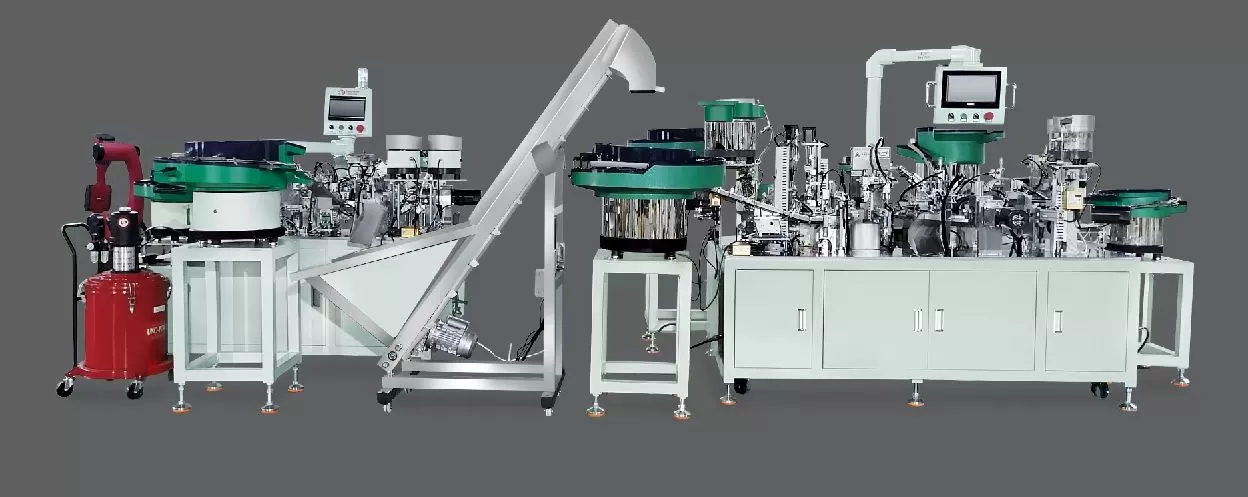
At the heart of modern manufacturing, precision mechanics isn’t just a buzzword—it’s the backbone of reliable, consistent products. From the hinges on a high-end cabinet to the telescopic slides in a commercial drawer, even the smallest inconsistency in assembly can lead to functional failures, customer dissatisfaction, or costly recalls. For Sanyhore, a leading manufacturer of hinge assembly machines, telescopic drawer slide assembly machines, and roll forming machines, the mission is clear: eliminate variability through engineering excellence and cutting-edge technology. This article explores how Sanyhore’s precision machines redefine quality control, ensuring every unit meets the highest standards.
1. The Core of Precision: Engineering Design
The foundation of Sanyhore’s quality lies in its meticulous engineering design. Unlike generic machines that rely on off-the-shelf components, Sanyhore’s engineers start with a blank canvas, tailoring each system to the specific demands of hinge and slide production. For hinge assembly machines, this means integrating high-precision cam mechanisms and micro-adjustable tooling, ensuring each hinge pin is inserted with 0.01mm accuracy—tight enough to prevent wobbling but flexible enough to accommodate minor material variations.
Telescopic drawer slide assembly machines, another Sanyhore specialty, use a modular design that allows for seamless adaptation to different slide lengths and load capacities. By combining computer-aided design (CAD) with finite element analysis (FEA), the team simulates stress distribution and motion paths, ensuring the machine’s moving parts—like ball bearings and rails—work in harmony. This level of design precision eliminates “loose fits” that often plague mass-produced alternatives, laying the groundwork for consistent performance.
2. Automation and Calibration: Reducing Human Error
Human error is a persistent challenge in manufacturing, but Sanyhore’s machines minimize reliance on manual intervention. At the core of this is advanced automation, where servo motors, encoders, and programmable logic controllers (PLCs) work in tandem to execute repetitive tasks with unwavering accuracy. For example, in hinge assembly, the machine automatically feeds, aligns, and crimps hinge components without human adjustment, reducing the risk of misplacement or over-tightening.
Equally critical is Sanyhore’s commitment to proactive calibration. Every machine undergoes a pre-shipment calibration process that tests 20+ parameters, from motor speed to tooling pressure. Post-delivery, the system includes built-in calibration reminders, ensuring operators can quickly adjust for wear or environmental changes (e.g., temperature fluctuations). This “set-it-and-forget-it” approach, combined with real-time feedback loops, keeps production within tight tolerances, even as machines run 24/7.
3. Material Handling: Ensuring Reliable Inputs
A machine’s output quality depends heavily on the inputs it receives. Sanyhore’s machines address this by integrating intelligent material handling systems. For roll forming machines—used to shape metal strips into slide rails—sensors detect material thickness, flatness, and hardness before each pass, adjusting the forming dies in milliseconds to compensate for variations. If a batch of steel is slightly thinner than standard, the machine automatically increases pressure on the relevant roll, ensuring the final rail meets the required specifications.
Similarly, hinge assembly machines use vision systems to inspect incoming components, such as pins and plates, for defects like burrs or dimensional errors. Rejects are sorted out before assembly, preventing flawed parts from ruining an entire run. By treating material consistency as a starting point, Sanyhore ensures that every machine’s output is uniform, regardless of raw material variations.
4. Real-Time Quality Monitoring: Data-Driven Control
In today’s manufacturing landscape, data is a powerful tool—and Sanyhore’s machines are built to collect and analyze it. Each machine is equipped with onboard sensors that track metrics like production speed, tooling wear, and assembly force. This data is fed into a cloud-based dashboard, where operators and engineers can monitor trends in real time.
For instance, if a telescopic slide assembly machine suddenly shows an increase in “slide resistance,” the system flags it as a potential issue. Engineers can then review historical data to identify if the problem stems from a worn bearing or a change in material quality, allowing for targeted fixes before a batch of defective slides is produced. This data-driven approach not only catches issues early but also helps refine processes over time, ensuring long-term consistency.
5. Sustained Innovation: Adapting to Industry Demands
The manufacturing industry evolves rapidly, with new materials, tighter tolerances, and shifting consumer preferences. Sanyhore’s commitment to innovation ensures its machines stay ahead of the curve. The R&D team regularly updates machine software and hardware, integrating new technologies like AI-powered predictive maintenance and IoT connectivity.
For example, the latest iteration of Sanyhore’s hinge assembly machines includes machine learning algorithms that adapt to tooling wear patterns, automatically adjusting settings to maintain quality. This adaptability means the machines can handle new hinge designs or materials without requiring a complete overhaul, reducing downtime and ensuring consistent performance as production needs change.
Common SEO Questions About Sanyhore’s Precision Machines
Q: How does Sanyhore’s hinge assembly machine ensure consistent quality in mass production?
A: Our hinge assembly machines combine precision engineering, automated alignment, and real-time calibration to maintain tight tolerances, ensuring each hinge meets strict quality standards regardless of production volume.
Q: What makes Sanyhore’s telescopic drawer slide assembly machine different from competitors?
A: Unlike generic machines, ours integrates advanced sensors and data analytics to adapt to material variations and tooling wear, delivering uniform slide performance even in high-speed production.
Q: Can Sanyhore’s roll forming machines handle different materials for slide rails?
A: Yes, our roll forming machines include adaptive material handling systems that adjust to variations in thickness, hardness, and flatness, ensuring consistent rail quality across diverse input materials.
For inquiries about Sanyhore’s hinge assembly machines, telescopic drawer slide assembly machines, or roll forming machines, contact our sales manager at +86 13425506550 or email info@sanyhore.com. Let us help you elevate your production quality today.


