

 - 副本.png)
Introduction to Automatic Hinge Assembly Systems
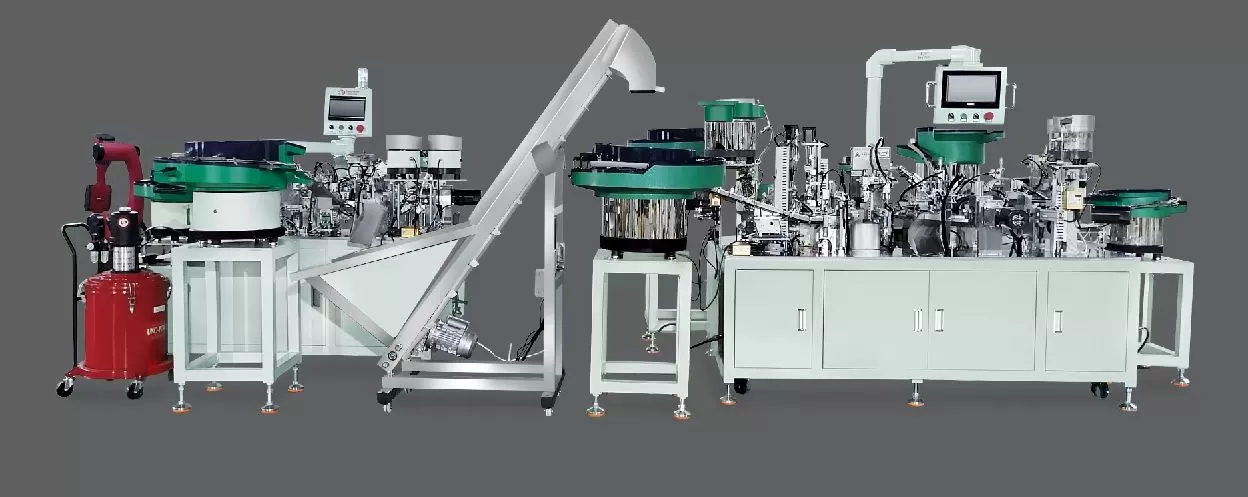
In modern manufacturing, the demand for high-efficiency, low-cost production has driven the widespread adoption of automatic assembly machines. For hinge manufacturing, in particular, such systems eliminate manual errors, reduce labor intensity, and ensure consistent product quality. This article details the complete process flow of the Jieyang hinge automatic assembly machine, a specialized equipment designed to streamline hinge production from raw material input to final packaging. As a professional manufacturer of hinge assembly machines, telescopic drawer slide assembly machines, and roll forming machines, Sanyhore leverages advanced engineering to deliver reliable solutions tailored to industrial needs.
1. Feeding and Orientation: Ensuring Continuous Raw Material Supply
The first step in the assembly process is the feeding system, a critical component that ensures continuous and accurate delivery of hinge components. Equipped with a vibration feeding tray and precision conveyor tracks, the system efficiently separates individual parts—such as hinge bases, leaves, pins, and springs—from bulk storage. The vibration frequency and track angle are fine-tuned to prevent jamming and ensure each component is oriented correctly before transfer to the next station. This initial stage minimizes downtime by maintaining a steady supply, a key factor in the machine’s overall production efficiency.
2. Precision Positioning: Locking Components in Place
Once components are fed, the next challenge is precise positioning to align parts for assembly. A multi-axis positioning mechanism, typically driven by high-precision伺服电机 (servo motors) and guided by linear rails, moves each component to the exact assembly point. For example, the hinge base is placed on a fixed positioning table, while the leaf and pin are clamped by pneumatic fixtures with adjustable grips. Vision sensors integrated into the system further verify positional accuracy, ensuring no misalignment occurs before the assembly phase. This step guarantees that subsequent operations—such as pin insertion or welding—are performed with minimal deviation, reducing the risk of defective products.
3. Component Assembly: Merging Parts into a Functional Hinge
The core assembly stage involves combining the pre-positioned components into a single functional hinge. Depending on the hinge type (e.g., butt hinge, continuous hinge), this phase may include pin insertion, spring installation, or welding. For instance, a pin insertion mechanism uses a pneumatic press to drive the hinge pin through the aligned leaf and base, with force sensors controlling the insertion depth to prevent over-pressing or under-pressing. Similarly, spring integration involves a robotic arm that places and compresses the spring into the hinge structure, ensuring proper tension for smooth operation. Advanced tooling, such as ultrasonic welding or laser welding, may be employed for joining metal components, ensuring strong, durable bonds.
4. Quality Inspection: Safeguarding Product Reliability
After assembly, a dedicated quality inspection station validates the hinge’s performance and structural integrity. This stage typically includes multiple checks: dimensional inspection using automated calipers or 3D scanners to confirm compliance with design specifications; functional testing to ensure the hinge opens and closes smoothly with consistent resistance; and visual inspection via high-resolution cameras to detect surface defects or misalignments. Components that fail any inspection are automatically diverted to a reject bin, while passing products proceed to packaging. This rigorous testing ensures only high-quality hinges reach the market, enhancing customer satisfaction and brand reputation.
5. Packaging and Finalization: Preparing for Delivery
The final step in the process is packaging, where qualified hinges are prepared for shipment. The packaging system, often integrated with the main assembly line, sorts products by batch, places them into anti-static bags or boxes, and applies labels with batch numbers and quality certifications. For large-scale orders, the machine may also interface with automated storage systems to optimize warehouse space. Before completion, the entire assembly line undergoes a final system check to confirm all components—from feeding to packaging—are operating at peak performance, ensuring the machine is ready for extended production runs.
Why Choose Sanyhore for Hinge Assembly Solutions?
As a trusted manufacturer with years of experience in automatic assembly technology, Sanyhore specializes in designing and producing hinge assembly machines, telescopic drawer slide assembly machines, and roll forming machines. Our equipment combines cutting-edge automation with modular design, allowing for easy customization to meet specific production requirements, such as hinge size, material type, or output capacity. We prioritize precision and reliability, using high-grade materials and components to ensure long-term machine stability. For inquiries about the Jieyang hinge automatic assembly machine or to discuss your production needs, contact our sales manager: +86 13425506550 or send an email to info@sanyhore.com. Let Sanyhore help you elevate your hinge manufacturing efficiency.


