

 - 副本.png)
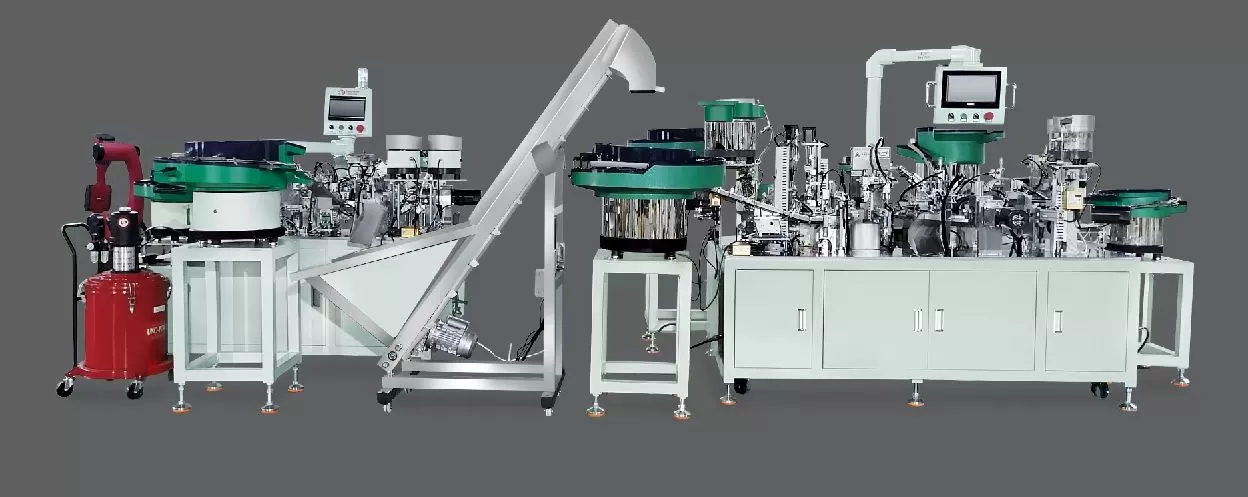
The global manufacturing sector is undergoing a profound transformation, driven by the rise of smart factories. These advanced production environments leverage interconnected technologies—such as the Internet of Things (IoT), big data analytics, and artificial intelligence (AI)—to optimize efficiency, reduce errors, and enable real-time decision-making. Central to this shift is the need for specialized machinery that can seamlessly integrate into these intelligent ecosystems, minimizing manual intervention and maximizing output. Among the key solutions reshaping hinge production, Sanyhore’s 3D hinge assembly machine stands out as a critical tool, offering precision, automation, and adaptability that aligns with the demands of modern smart factories.
#The Evolution of Hinge Assembly in Smart Factories
Traditional hinge assembly processes have long relied on manual labor, which is not only time-consuming but also prone to inconsistencies. In smart factories, where scalability and quality control are paramount, such inefficiencies are no longer acceptable. Hinge components, used in everything from furniture to automotive systems, require tight tolerances and consistent performance, making precision a non-negotiable factor. As smart factories prioritize data-driven workflows, the transition from manual to automated hinge assembly has become imperative. Sanyhore’s 3D Hinge Assembly Machine addresses this need by combining cutting-edge engineering with smart factory compatibility, positioning it as a cornerstone of modern hinge production lines.
#Key Technical Features of Sanyhore 3D Hinge Assembly Machine
At the heart of Sanyhore’s 3D Hinge Assembly Machine lies its advanced 3D vision system, which enables real-time, high-precision positioning of hinge components. Unlike conventional 2D systems, the 3D capability ensures accurate detection of even micro-irregularities in parts, allowing the machine to adjust assembly parameters dynamically. This precision is further enhanced by multi-axis联动 (multi-axis linkage), with integrated X, Y, and Z axes that facilitate complex hinge configurations with minimal human input. Additionally, the machine is equipped with IoT-enabled sensors that monitor operational data—such as assembly force, speed, and component wear—providing actionable insights to operators and enabling predictive maintenance. These features collectively make the 3D Hinge Assembly Machine a versatile solution for both standard and custom hinge designs.
#Enhancing Production Efficiency Through Automation
In smart factories, efficiency is often measured by throughput and cycle time. Sanyhore’s 3D Hinge Assembly Machine excels in both areas. By automating repetitive tasks, the machine reduces dependency on manual labor, allowing manufacturers to reallocate human resources to more strategic roles, such as process optimization and quality control. The machine’s high-speed operation, supported by optimized algorithms, achieves cycle times as low as 5–8 seconds per hinge, significantly outpacing traditional manual methods. Furthermore, its ability to run 24/7 with minimal downtime—thanks to robust construction and predictive maintenance—ensures consistent high output, a critical advantage for meeting tight market demands in today’s competitive landscape.
#Ensuring Precision and Quality in Mass Production
For hinge components, even minor deviations in assembly can lead to functional failures or increased customer complaints. Sanyhore’s 3D Hinge Assembly Machine mitigates this risk through its integrated quality control systems. The 3D vision system not only positions parts accurately but also performs in-line inspections, verifying critical dimensions like hinge alignment, torque, and seam integrity. This real-time quality monitoring ensures that only compliant products proceed to the next stage, reducing rework and scrap rates. By combining precision assembly with built-in testing, the machine helps manufacturers maintain strict quality standards, a key requirement for securing certifications and building customer trust in the smart factory era.
#Integration with Smart Factory Ecosystems
Smart factories thrive on connectivity, and Sanyhore’s 3D Hinge Assembly Machine is designed to integrate seamlessly with existing industrial ecosystems. It can be easily connected to manufacturing execution systems (MES), enterprise resource planning (ERP) software, and IoT platforms, enabling data sharing across the production line. For example, production data—such as output rates, component usage, and machine performance—can be aggregated in real time, allowing managers to identify bottlenecks and optimize workflows. Additionally, the machine supports Industry 4.0 protocols, such as OPC UA, ensuring compatibility with other smart devices and systems. This integration not only enhances operational visibility but also paves the way for the development of digital twins, virtual replicas of production lines that can simulate and optimize processes before physical changes are made.
#Future-Proofing Manufacturing with Advanced Hinge Assembly
As smart factory technologies continue to evolve, the demand for more flexible and adaptive production systems will grow. Sanyhore’s 3D Hinge Assembly Machine is engineered with this future in mind. Its modular design allows for easy reconfiguration to accommodate new hinge designs or production requirements, reducing the need for expensive overhauls when scaling operations. The machine’s open architecture also supports the integration of emerging technologies, such as AI-driven process optimization and collaborative robots, further enhancing its capabilities over time. For manufacturers looking to future-proof their operations, the 3D Hinge Assembly Machine offers a balance of current performance and long-term scalability.
For inquiries about Sanyhore’s hinge assembly machines, telescopic drawer slide assembly machines, or roll forming machines, contact our sales team at +86 13425506550 or email info@sanyhore.com. Partner with Sanyhore to elevate your smart factory’s production capabilities and drive sustainable growth in the manufacturing industry.


