

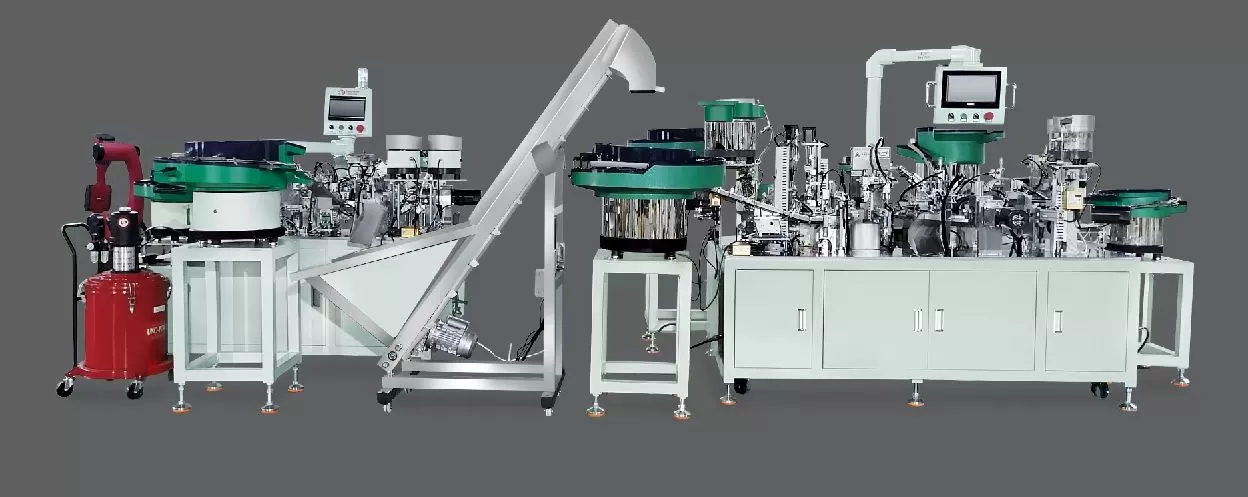
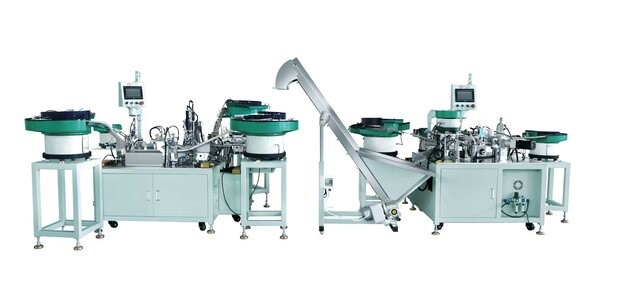
Jieyang, a renowned hub for hardware manufacturing in China, has long been celebrated for its expertise in producing high-precision hinges. At the heart of this industry's advancement lies the 3D hinge assembly machine, a sophisticated piece of equipment that merges cutting-edge technology with meticulous craftsmanship. This article delves into the technical principles and manufacturing artistry behind these machines, highlighting why they have become indispensable in modern hinge production.
The Core Technology: 3D Hinge Assembly Principles
At the core of 3D hinge assembly machines is their advanced 3D coordinate positioning system, a marvel of engineering precision. Unlike traditional 2D systems, 3D technology enables simultaneous control over X, Y, and Z axes, allowing for the exact alignment of multiple hinge components—such as pivot pins, bushings, and cover plates—with sub-millimeter accuracy. This is achieved through the integration of high-resolution linear guides, servo-driven motors with encoder feedback, and real-time data processing units. The system can adjust for minor material tolerances and component variations automatically, ensuring consistent assembly regardless of batch differences. This level of precision is critical for 3D hinges, which are widely used in applications requiring smooth, multi-directional movement, from high-end furniture to automotive interiors.
Precision Manufacturing Craftsmanship
The production of 3D hinge assembly machines themselves reflects the same meticulous craftsmanship that defines the hinges they create. Jieyang's manufacturers leverage a combination of CNC machining, precision grinding, and advanced material science to build the machines' structural and functional components. For instance, the machine bed is crafted from high-strength cast iron, subjected to aging treatment to eliminate internal stresses and ensure long-term stability. Key moving parts, such as the positioning arms and clamping mechanisms, undergo precision grinding to achieve surface finishes below Ra 0.8μm, minimizing friction and wear. Additionally, the integration of high-speed cameras and laser measurement tools enables in-process monitoring of component dimensions, ensuring each machine meets strict quality benchmarks before leaving the factory.
Automated Integration and Production Efficiency
Modern 3D hinge assembly machines are not standalone tools but part of a broader automated production ecosystem. Sanyhore, a leading manufacturer in this field, specializes in integrating these machines with automated feeding systems, vision inspection stations, and conveyor lines. This integration reduces manual intervention to less than 10% of the production process, significantly boosting efficiency and reducing human error. For example, the feeding system uses vibratory bowls and robotic grippers to sort and orient hinge parts, while the vision inspection station checks for missing components or misalignments in real time, ensuring only qualified products proceed to the next stage. Such automation has transformed hinge production, allowing manufacturers to handle high-volume orders with consistent quality.
Quality Control and Reliability Standards
Reliability is a cornerstone of 3D hinge assembly machines, and Sanyhore employs a multi-layered quality control system to ensure this. Incoming raw materials, including steel alloys and precision components, undergo rigorous material testing to verify mechanical properties, such as tensile strength and hardness. During assembly, the machines are calibrated daily using standard test fixtures, and each production run includes sample testing to validate alignment and performance. Post-assembly, every machine undergoes a 72-hour continuous operation test under simulated production conditions, monitoring parameters like speed, noise levels, and component durability. This comprehensive approach ensures that Sanyhore's machines consistently deliver stable performance, even in high-production environments.
Beyond Hinges: Diverse Applications of 3D Assembly Solutions
While 3D hinge assembly machines excel at producing hinges, their capabilities extend to related components, including telescopic drawer slides and other linear motion systems. Sanyhore's machines can be adapted to assemble telescopic drawer slide assembly machines, which are widely used in furniture manufacturing for their space-saving design and smooth operation. Additionally, the company's expertise in roll forming machine technology complements the hinge assembly process, enabling the production of custom slide rails with complex cross-sections. This versatility makes Sanyhore a one-stop solution provider for clients in furniture, automotive, and consumer electronics industries, where precision and reliability are non-negotiable.
Choosing the Right Partner: Sanyhore's Commitment to Innovation
In a market flooded with generic machinery, Sanyhore stands out by prioritizing innovation and customer-centric design. With a team of experienced engineers specializing in hinge and slide assembly technology, the company continuously refines its machines, incorporating features like IoT connectivity for remote monitoring and AI-driven predictive maintenance. Clients benefit from tailored solutions, whether for standard production lines or custom high-speed systems. For those interested in exploring 3D hinge assembly machines, telescopic drawer slide assembly machines, or roll forming machines, Sanyhore invites inquiries. Contact sales manager Mr. [Name] at +86 13425506550 or email info@sanyhore.com to discuss your specific manufacturing needs.


